104, Triq is-Sedqa,
Attard ATD 2315
Malta
Tel: +356 7961 7858 | +356 7941 7401 | +356 2141 7401
E-mail: info@gryphonmalta.com
VAT: MT 1668-9122


In a number of countries around Europe, such material is being recognised as the new generation of teaching material since three-dimensional structures are being understood spontaneously, thus speeding up learning significantly in all age categories and by pupils with different learning abilities.
All 3D material were specifically selected by Gryphon Malta so as to fit both the educational curricula for primary and secondary classes, as well as the majority of development plans designed for schools.
Pupils will improve their learning experience through repetitive visual interaction thus enabling students to effectively establish a link between schooling and their personal experiences where learning becomes more effective and fun!
True-3D images fascinate both young and old alike, all over the world.
Innovative 3D Material


How does True-3D imaging works?
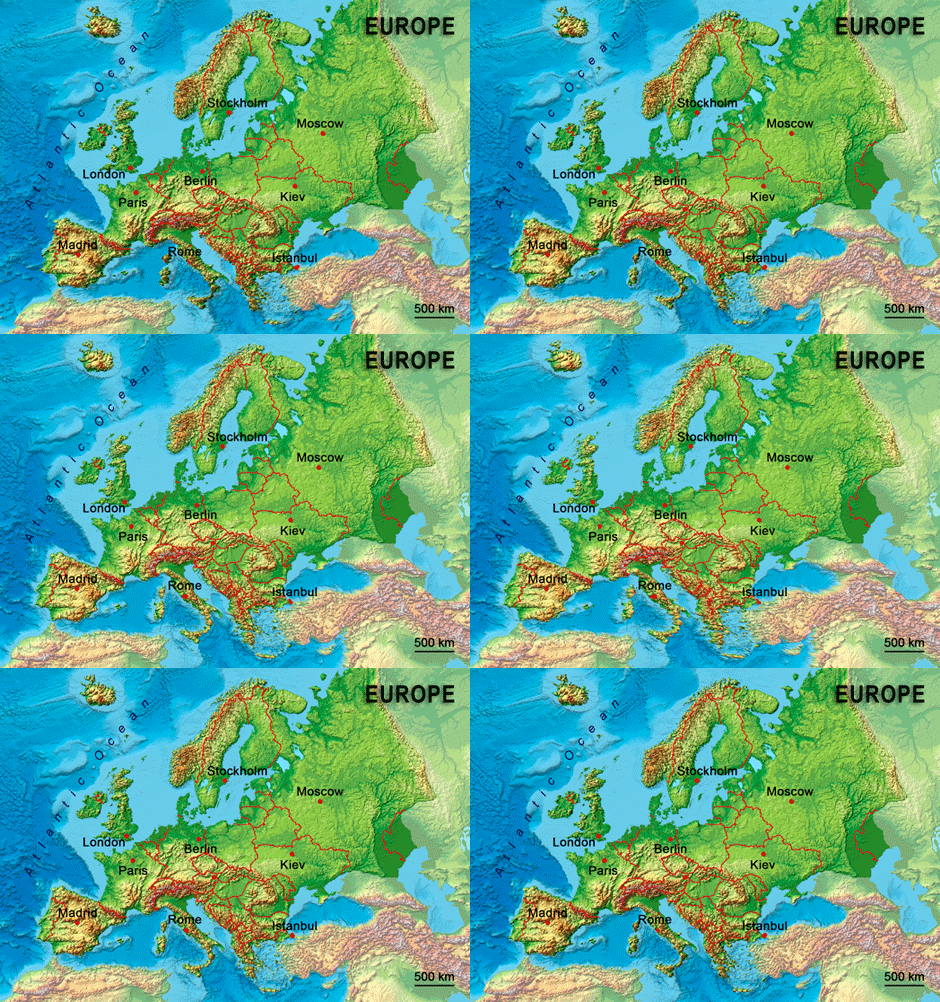
An interesting fact to discuss during one of the science sessions is the production of these innovative three dimensional products. When looking at real objects, our eyes perceive two slightly differing pictures. On the basis of this difference, the brain figures out the objects’ three-dimensional depth. Thus, the three-dimensional impression takes shape.
True-3D displays contain several shots of the same subject taken from different perspectives. These “takes” are slotted into each other, resulting into a highly complex process.

The lenses are accurately aligned with the interlaces of the image, so that light reflected off each strip is refracted in a slightly different direction, although the light from all strips of a given image are sent in the same direction.
Consequently, when looking at the pictorial content, each eye perceives only the visual information according to its current angle of view. This happens due to an exactly adjusted lenticular foil coating covering each display. Therefore, both eyes perceive a pictorial content that is slightly, yet decisively, differing in perspective – just like when looking at the real three-dimensional structure. Thus, the brain constructs the same three-dimensional picture.
Such a 3D phenomenon is capable of creating an illusion of depth of up to 60cm from a 1mm lens without any additional optical tools. Such a technology has the ability not only to create depth but also to change or move as the image is viewed from different angles. This is what makes True-3D images so fascinating for people all over the world.
Obviously there is no need of 3D glasses, special apparatus or any other tool to watch the 3D images of our product range

3D Stationary
There are nine different categories of 3D Stationary to use and enjoy!